

How To Set Bipap Settings

Starting non-invasive ventilation (CPAP and BiPAP)
How and when to start BiPAP and CPAP
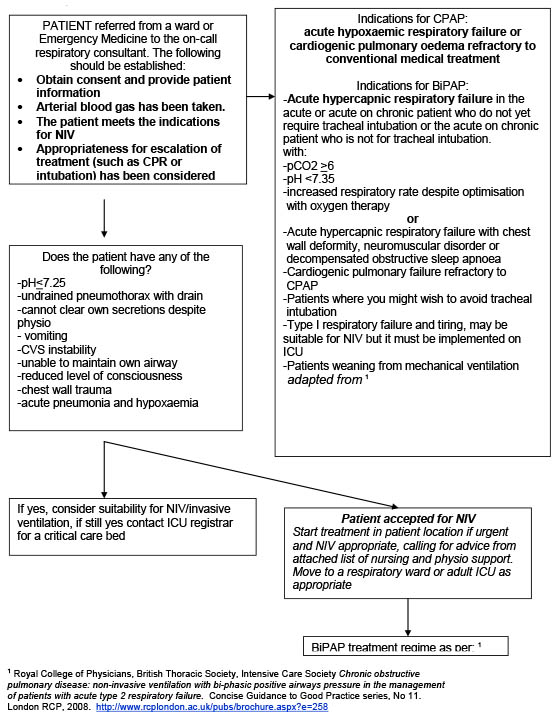
Non-invasive ventilation (NIV) refers to CPAP and BiPAP. This folio explains the practicalities of starting a patient on NIV. Encounter the intensive care pages for details and specific indications for CPAP and BiPAP (and high flow nasal oxygen – 'HFNO' or 'optiflow')
CPAP and BiPAP nuts
- CPAP (continuous positive airways pressure level)
- CPAP is delivered with a tight fitting mask fastened to a ventilator. It gives a continuous pressure level (coordinating to PEEP: positive cease expiratory pressure).
- Usual settings are 5, 7.5 or 10 cmH20
- CPAP is commonly used in astute pulmonary oedema later on medical management has failed
- The aim of CPAP is to splint airways, reduce alveolar collapse, enable alveolar recruitment and to increase the functional residual chapters
- BiPAP (bilevel positive airways pressure)
- BiPAP is also delivered by means of a tight fitting face mask simply the ventilator delivers two different airway pressures. These are an inspiratory pressure and an expiratory pressure.
- The expiratory pressure (EPAP) is analogous to PEEP on CPAP and is usually set betwixt four-six cmH2
- The inspiratory pressure (IPAP) is a higher force per unit area which aims to broaden the patient's inspiratory effort
- Common settings for IPAP are 12 cmH20 which tin can and so be escalated depending on the patient response. It can become up to xx cmH20 if needed.
- BiPAP is used to treat type ii respiratory failure and is normally used in exacerbations of COPD but just afterwards full medical direction in advisable patients.
What to consider earlier starting NIV
- Consent
- Should be sought whenever a patient has chapters and the ability to communicate
- Hereafter plans and ceilings of care should as well exist discussed with the patient and relatives where possible
- Contraindications
- There are various contraindications to NIV (see below). However, NIV may be used in the presence of the contraindications if life is threatened. Rationale should exist clearly documented.
- Make a plan in case of failure
- Is the patient appropriate for ICU? What is the ceiling of care? How long will you lot persist with NIV if it doesn't seem to be working?
- BTS suggest five categories of plans when starting NIV:
- If NIV fails in under 4 hours, escalate to intubation
- If NIV fails between 4-48hours, escalate to intubation
- If NIV fails NIV consider palliation if it is not advisable to proceed to invasive ventilation
- Continue NIV if in that location is a response to therapy and seek specialist respiratory input with regards to duration of therapy and weaning.
- Inappropriate to commence NIV and palliate from the outset
- In addition DNAR condition should be considered prior to commencing NIV. This is helpful but note that having a DNAR certainly does Non prevent the use of NIV (or invasive ventilation).
- Monitoring
- Both CPAP and BiPAP can reduce cardiac output and cause haemodynamic instability so it is of import to monitor pulse and claret pressure closely.
- Fluids and diet
- Whilst wearing an NIV mask the patient will have less oral intake and insensible losses will be higher.
- Monitor fluid rest and give iv fluids as necessary
- If NIV is to be worn for more than 24-48 hours then NG feeding should likewise be considered.
- Apply the narrowest bore NGT possible to reduce mask leakage
- Whilst wearing an NIV mask the patient will have less oral intake and insensible losses will be higher.
Setting up NIV
- Explicate
- NIV is unpleasant and lack of tolerance is a major reason for failure . Tell the patient about this and explain very clearly what NIV involves.
- Tell them you will start very slowly and move in steps. Acknowledge it is unpleasant but emphasise its importance.
- Prepare
- Get the correctly fitting mask to reduce whatsoever hurting
- Take a nurse in that location who is experienced with NIV – this is absolutely invaluable.
- The pressure from NIV often leads to bloating and nausea. Give an antiemetic and consider an NGT prophylactically to reduce gastric pressure
- Put on the mask
- Get-go past setting up the force per unit area settings with the mask no on the patient.
- Position the mask near the patient's face so they can feel the air blowing into their face without the mask touching them
- Then concord part of the mask on their face – give them time to adjust
- When ready, hold the mask to their face letting them get use to the pressure
- When they have got used to this then put on and tighten the straps to ensure a proper fit.
- You should stay with them throughout this fourth dimension
- Starting NIV settings
- CPAP
- Usual settings are five, seven.5 or 10 cmH20
- BiPAP
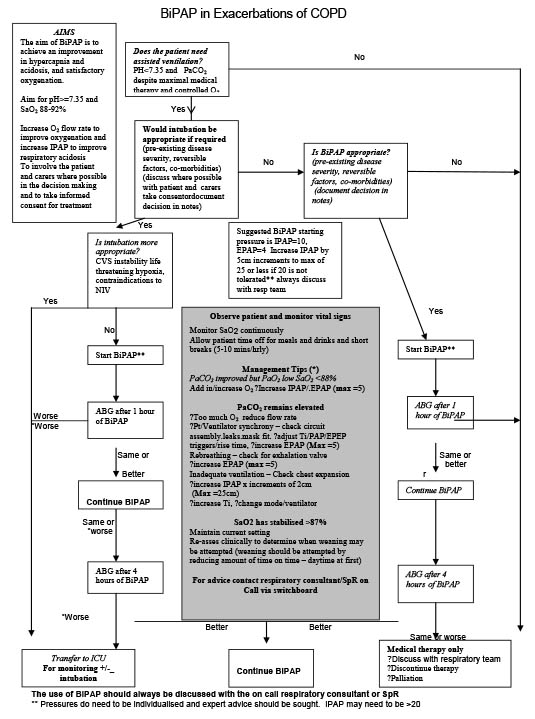
- The aim is to embark BiPAP at settings of 12 cmHiiO/4cmH2O (EPAP of 12, IPAP of 4) and escalate the IPAP:
- Commencement EPAP at 4 or v cmH2O
- Beginning IPAP at 10 cmH2O titrated speedily in two-5 cm increments at a rate of approximately 5cmH2O each 10 minutes with a usual pressure target of 20cms Water or until a therapeutic response is accomplished or patient tolerability has been reached.
- Setting changes should be guided past series ABGs and the respiratory or ICU teams should be involved to assistance guide this.
- The aim is to embark BiPAP at settings of 12 cmHiiO/4cmH2O (EPAP of 12, IPAP of 4) and escalate the IPAP:
- CPAP
Monitoring of NIV
- Try to stay with the patient for at least five minutes to ensure they are comfortable. Use this time to start optimising settings
- Arterial blood gases should be taken as a minimum at ane, 4 and 12 hours after the initiation of NIV
- A decision to keep to invasive mechanical ventilation should normally be taken within 4 hours of initiation of NIV
- Intubation where appropriate is the direction of choice in belatedly (>48hrs) NIV failures
- With both CPAP and BiPAP the inspired oxygen (FiO2) can exist titrated to reach a target PaO2 or saturations.
- Close monitoring and series blood gases are imperative for any patient being treated with non-invasive ventilation and then whatever improvements or deteriorations in the clinical state can quickly be identified.
How to wean NIV
- Initially weaning should exist during the solar day with extended periods off the ventilator for meals, physiotherapy, nebulised therapy etc.
- Later successfully weaning during the day, most patients will require an boosted night on NIV.
- Usual exercise involves a 4-mean solar day weaning period
- Twenty-four hour period ii: Go on NIV for 16 hours (including 6-eight hours overnight)
- Day 3: Proceed NIV for 12 hours (including vi-8 hours overnight).
- 24-hour interval 4: NIV may be discontinued unless continuation is clinically indicated
- e.yard. 2 hours in the morning, two hours in the afternoon and six hours overnight
- Some patients make a rapid recovery and shorter weaning periods of ii-3 days are often reasonable
Contraindications to NIV
- Facial burns/facial trauma
- Recent upper GI surgery
- Vomiting
- Fixed airway obstacle
- Undrained pneumothorax
- Patient is unable to protect their own airway
- eastward.g. moribund with low GCS or copious secretions
- Life threatening hypoxaemia
- Multiple comorbidities
- Confusion and agitation (unless caused past hypoxia or hypercapnoea which would be reversed past NIV)
- Patient refusal
- Bowel obstruction
- Haemodynamic instability requiring inotropes (unless on ICU)
- NIV is non the handling of choice for patients with consolidation on CXR but is sometimes used if escalation to intubation and ventilation is deemed inappropriate
Click hither to download complimentary British Thoracic Society (BTS) guidelines on starting non-invasive ventilation : Not-invasive ventilation
Perfect revision for medical students, finals, OSCEs and MRCP PACES
BTS guidelines on indications for NIV
BTS guidelines on starting BiPAP for COPD
Source: https://oxfordmedicaleducation.com/clinical-skills/procedures/starting-niv/
0 Response to "How To Set Bipap Settings"
Post a Comment